Wednesday, January 22, 2020

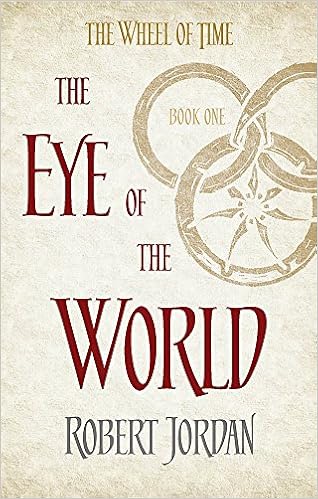
The Wheel of Time I: The Eye of the World by Robert Jordan

The Spiel of Grime: The Eye of the Turd


For a genre called “fantasy”, it’s amazing how much of it is the exact fucking same.


An orphaned child who’s the chosen one. A mystical mentor who always knows exactly what’s going on. An evil lord unironically called “The Dark One”. Villains capable of talking only in clichés. A magical plot device called the Capitalized Noun of X. The Eye of the World has all of them and then some. 

I hardly even need to recap the premise for the sake of this review, because you’ve all heard it before. But still, for the sake of coherency:
Rand Al’Thor and three of his friends have their village attacked by non-copyright infringing orcs called Trollocs. A mysterious witch named Moiraine and her gruff ranger sidekick Lan announce that one of them is naturally the Dragon Reborn, the chosen one who will bring goodness back yadda yadda yadda.

The vast majority of the book is then this group trying to get to Tar Valon, hunted by more utterly disposable trollocs. Along the way, Rand and his friends Mat and Perrin are visited by a strange figure in their dreams who spews out the most laughably pathetic threats that make Captain Planet’s villains look like MacBeth in comparison.

What’s worse than Jordan telling a story we’ve all heard a million times before is that he can’t even tell it particularly well. The pacing and structure are abysmal. We never even learn what the villain’s plan is until 600 pages in; it reads like Jordan forgot to give his book a plot more developed than gormless twats running around the countryside bumping into random people, so just stapled a climax onto the end. Characters espouse pages of boring exposition that has little to no relevance to the story; the second act is littered with disposable subplots about our heroes meeting random goons, learning some of their history, and then leaving, never to mention or see them again. We meet a man who can possess wolves, the queen, not-Gypsies (who alternate from being loved by everyone to being hated by everyone within a chapter), and about thirty million inane pubs and taverns filled with unreasonable bell-ends who seemingly have no purpose in life except to drink and start fights.

A common criticism of Robert Jordan’s writing is that he can’t write women. I would like to amend that; he can’t write ANYBODY! Perrin and Rand are about as engaging and dynamic as wet cardboard; they’re both dragged along on a journey they don’t seem to care about at all, always letting someone else seize the initiative. Mat and Egwene, on the other hand, both have some semblance of personality, it’s just that Jordan makes it the most unlikeable personality ever. Egwene is pretty much the epitome of “strong independent women” characters written in the nineties by middle-aged men; all she does is complain about men. This is actually a welcome break from Mat, as he complains about fucking everything.

Moiraine is clearly a pastiche of Gandalf, except vacuum-sealed of all personality or weakness. Lan doesn’t seem to have any real personality until we’re suddenly told halfway through the final act that he’s actually a rip-off of Aragorn. And no, this has absolutely no impact on his character or the plot. He slots nicely into the “gruff and cynical mentor with a heart of gold”, an archetype Jordan shamelessly uses three more times.

There are a few specks of vaguely interesting worldbuilding here and there. But Jordan never bothers integrating this into the story, it’s just dropped on us in boring unreadable infodumps.
I had already long consigned the rest of the series into my “do not read” pile, but even if I hadn’t, the moment I found out a later book features a female villain defeated through public spanking would have sent the sequels straight to the crematorium. Without wishing to kinkshame, the author’s spanking fetish apparently pops up throughout the series enough times to rival the ubiquity of feet in a Tarantino flick. 

Absolutely not worth anyone’s time. I’m astonished as to how anyone could slog through fourteen books of this bland, derivative, boring mess.

2/10


Recommended Instead: A Game of Thrones by George R. R. Martin. It’s just as long, except Martin remembers to include things like “plot” and “character”.

Wednesday, January 15, 2020

Star Wars: From a Certain Point of View

Star Bores: From a Certain Point of Poo (Or, The Force-Kin Awakens)

I've never met anyone who doesn't hate at least one Star Wars film. The dialogue from Clones, the mind-numbing pace of Menace, the blatant retreading of Awakens, the stupid teddy-bear things from Return, whatever the fuck Rise was about…

The only film that isn't someone's greatest disappointment since their son is A New Hope, so naturally, as the fortieth anniversary of its release approached, Disney graced us with From A Certain Point of View. Even I, a person whose sole experience with the expanded universe was reading the back of The Unseen Queen and deciding it sounded excruciating to the point of genuine illness, was engaged by the premise of FACPOV; it's A New Hope told from the perspective of forty-odd background characters, each chapter written by a different author and from the view of a different person. Or, as the case may be, scrotum-chinned alien.

The flaws inherent to such a venture become obvious after ten or so stories. Take your pick: either a scene ripped directly from the film with the odd original thought from whoever's POV it is that comes across as a glorified DVD commentary; an original story with elements of a New Hope shoehorned in, usually as trite and desperate as "Luke Skywalker walks through one scene, saying or doing nothing"; or reapplying context to a scene already in the film. The last option sounds superior at first, but once you've seen Han Solo shoot Greedo for the fourth time you'll be begging for a change of pace.

I'm highlighting the flaws inherent in the system not to criticize but to alleviate; yes, most of the stories are pretty mediocre, but given how difficult these restraints were "mediocre" could have been a lot worse.

The "retelling of a scene we already saw" stories end up being the weakest; about the strongest element introduced in any of them is "Greedo was an incel". I never found myself looking at a character in a new light or understanding their perspective more. The worst offender is the very first story in the anthology, Raymus. It's from the perspective of Captain Antillies, the poor guy Vader strangles at the very start after he refuses to reveal where the Death Star plans are. The story manages to make Antilles the most generic "brave military leader" archetype possible, and it had me worried most of the other stories would be this drab.

The lack of collaboration between authors is also obvious at times; Greedo is depicted as a known idiot in one story, then as a Rodian with a dangerous reputation in the next one. Towards the end we're hit with four retellings of the Death Star fight with so little variation you'll probably have memorized all of Luke's dialogue by the end.

Only three stories managed to enhance the original film while also being strong standalone pieces: The Sith of Datawork by Ken Liu, a blisteringly original take on the Empire as a beauracratic mess collapsing under its own weight; An Incident Report by Daniel Lavery, a darkly humorous look at the mind of Motti, the poor sap Vader force chokes; and by Alexander Freed, a brilliant character piece on Mon Mothma. A lot of stories are painfully close to joining them but screw up on a single issue; Not for Nothing and Stories in the Sand both have fantastic premises and openings but are let down by unsatisfying ending, primarily because they're forced to fit into the film's narrative. The Baptist is a brilliantly claustrophobic tale about the trash compactor monster of all things, but it tries to do far too much in too short a time. There’s a trite attempted rape scene early on, and it adds so little to the narrative it honestly comes across as crass and offensive. Please, sexual assault is so far from the tone of Star Wars it should be limited to scenes that have aged about as well as Jim’ll Fix It.  

Overall, From A Certain Point of View is a flawed if decent anthology for anyone interested in Star Wars. If the premise alone interests you it's at least worth checking out.

6/10


Next week: Lincoln in the Bardo by George Saunders